
Dishwasher leaking water? Look at the puddle first
Did someone squeeze hand dish soap into the detergent cup? It foams water out past the door, and those suds can take several hours to die down. Rule that out, then let the spot where the water lands point you to the part.
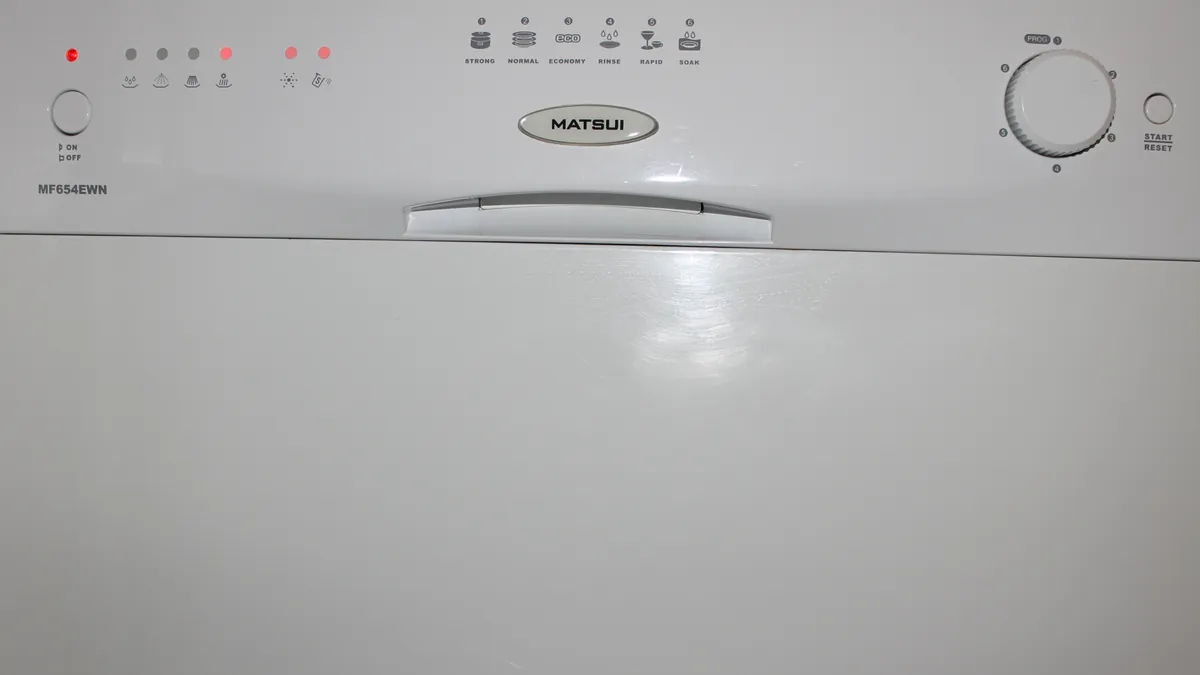
Where is the water showing up?
The location of the puddle narrows the cause before anything comes apart. Whirlpool sorts leaks this way, and a Honolulu technician starts in the same place.
| Where it shows | Usual suspects | What you might see | Safe first step | Who fixes it |
|---|---|---|---|---|
| Door edge or lower corners | Door gasket, too many suds, a spray arm aimed at the door | Foam in the tub, a seal out of its channel | Seat the seal, switch to automatic dishwasher detergent | You, unless the seal is torn |
| Under the middle | Pump seal, sump, an overfill | Water spreading from beneath the kickplate | Power off, towel down, note when in the cycle it appears | Technician |
| Behind or beneath the cabinet | Supply hose, inlet valve, drain line | Damp floor at the back, wet hose fittings | Run a hand along the supply hose and both its ends | Hose ends you can snug; the valve is a service job |
| Front only, machine tilts | Unit lower at the front | Water collecting at the door bottom | Check level side to side and front to back | Leveling feet; a technician if it is screwed in tight |
Why is my dishwasher leaking?
Suds are the most common reason a dishwasher leaks, from hand dish soap, too much detergent or spilled rinse aid. Next comes the door gasket: pushed out of its channel, torn, or new and still seating over its first several cycles. A machine set lower at the front pools water at the door, and a control panel rubbing the next cabinet can let the door latch without sealing. Water behind or under the unit means the supply hose, the inlet valve or the drain line. Least common are a worn pump or diverter seal, an overfill from a sticking valve or float, or a cracked tub. Wipe the floor dry and run one fresh cycle before blaming any part.
Which part is letting water out?
| Cause | How you can tell | Owner check or technician job |
|---|---|---|
| Suds | Foam at the door, the wrong soap in the cup, a rinse aid spill | Owner check: wait for the foam to settle, use only automatic dishwasher detergent |
| Door gasket | Drips along one edge; seal sagging or loose | Owner check: press it back into its channel; a damaged seal is a service item for Samsung |
| Level or cabinet fit | Leak began after an install; panel edge touches the cabinet | Owner check for level; refitting the mounting screws is a technician job |
| Supply hose or inlet valve | Wet at the back even with the door shut | Inspect the hose; a failing valve is a technician job |
| Pump seal, diverter seal or overfill | Water from under the center, water level higher than usual | Technician job |
| Cracked tub or drain hose leak | Leak survives a new gasket and releveling | Technician job |
A slow drip costs more in a damp Honolulu home
EPA says water from a leak should be dried within 24 to 48 hours, before mold can start. On Oahu that clock is tight: windward lowland air sits at roughly 70 to 80 percent humidity, so a wet subfloor under a dishwasher stays wet. In a condo the risk travels too, because the water can reach the unit below. Treat any repeat puddle as a repair, not a mopping chore.
How is a dishwasher leak pinned down?
Dry run
Everything is wiped dry and a short cycle runs while the technician watches, so a spill from loading is never mistaken for a failed part.
Trace it
The kickplate comes off and a light goes underneath. Where the first drop forms, and at which stage of the cycle, picks the suspect.
Fit and seal
Level, mounting screws, the gasket and any corner baffles are checked, since a bowed tub wall or a gap at the corners leaks with every wash.
Valve and pump
The inlet valve, float, pump seal and drain hose are tested last. After the repair a full cycle runs dry on a clean Honolulu kitchen floor.