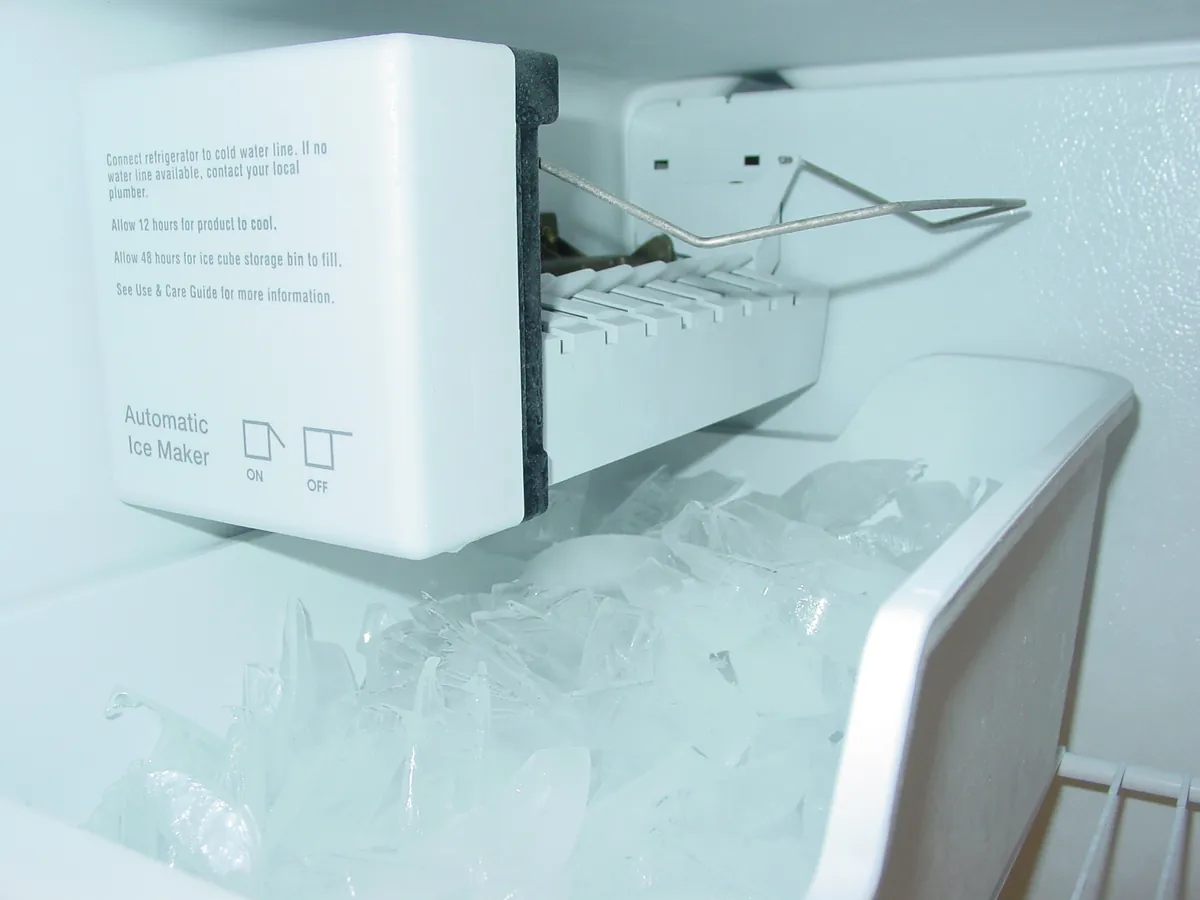
Ice maker leaking water? Follow the wet spot
Find the water before you hunt for the fault. A loose connection can leave a puddle at the bottom of the fresh-food section, a drip by the door hinge, or a wet patch at the house connection behind the fridge.
Why is my ice maker leaking water?
Most ice maker leaks start at a water connection rather than in the ice maker itself. Check the fittings at the water valve, the 1/4 inch line where it meets the saddle valve, and the fill tube extension first. The filter comes next, since a cracked housing or a missing O-ring drips whenever water moves. Then rule out look-alikes: a clogged defrost drain or a cabinet that is not level can put water right where an ice maker leak would show. On some door ice makers a gap at the bucket gasket melts ice that drips from the chute. Last on the list is a leaking water valve on the fridge, which is a technician job.
How is an ice maker leak tracked down?
Shut off
Turn the ice maker off, then close the supply valve, usually under the sink, clockwise until it stops. Unplug the fridge before pulling it out.
Dry and watch
On the Honolulu visit every surface is dried first. Then water runs through the dispenser and a fill cycle so the first new drop shows its source.
Lines
Fittings, the saddle valve, the fill tube extension and the filter head are checked. On two-line Samsung side-by-sides, the hookups are confirmed the right way round.
Fix
A loose fitting is reseated, a cracked filter or worn valve replaced, and the cabinet leveled so melt water heads to the drain before the Honolulu technician leaves.
Leak sources, most to least common
| Cause | How you can tell | Owner check or technician job |
|---|---|---|
| Loose fitting or supply line | Wet at the house connection behind the unit, at the hinge or the fresh-food floor | Owner check with the valve closed: look for drips at each joint; a reseat that does not hold needs service |
| Cracked filter or missing O-rings | Drips at the filter head, often after a recent change | Owner check: replace the filter with the right part |
| Drain or level look-alike | Ice on the freezer floor, or the cabinet tips forward | Owner check for level; a clogged drain is usually service |
| Melting at the door bucket | Door ice maker; drips from the ice chute, not the floor behind | Owner check: level the cabinet so the bucket meets its gasket |
| Supply lines reversed | Samsung RS27T or RS22T side-by-side; leaks each time water is dispensed | Technician job to swap the hookups |
| Leaking water valve | Water at the back of the cabinet with every fill | Technician job |
Why a small drip matters more in a damp Honolulu home
An ice maker line leaks a little at a time, often under or behind the cabinet where nobody looks. EPA says water from a leak should be dried within 24 to 48 hours to keep mold from starting, and it wants indoor humidity below 60 percent. Windward lowlands commonly run 70 to 80 percent, so a wet floor under a fridge in Honolulu or Kailua dries slowly. In a condo the same water can travel down to a neighbor.